Board reading
Double threats: open threes, fours, and forks
A double threat is the moment one stone creates two replies your opponent cannot both make. Most finished games of freestyle Gomoku end that way. The useful skill is noticing the pressure one or two moves before the fork lands.
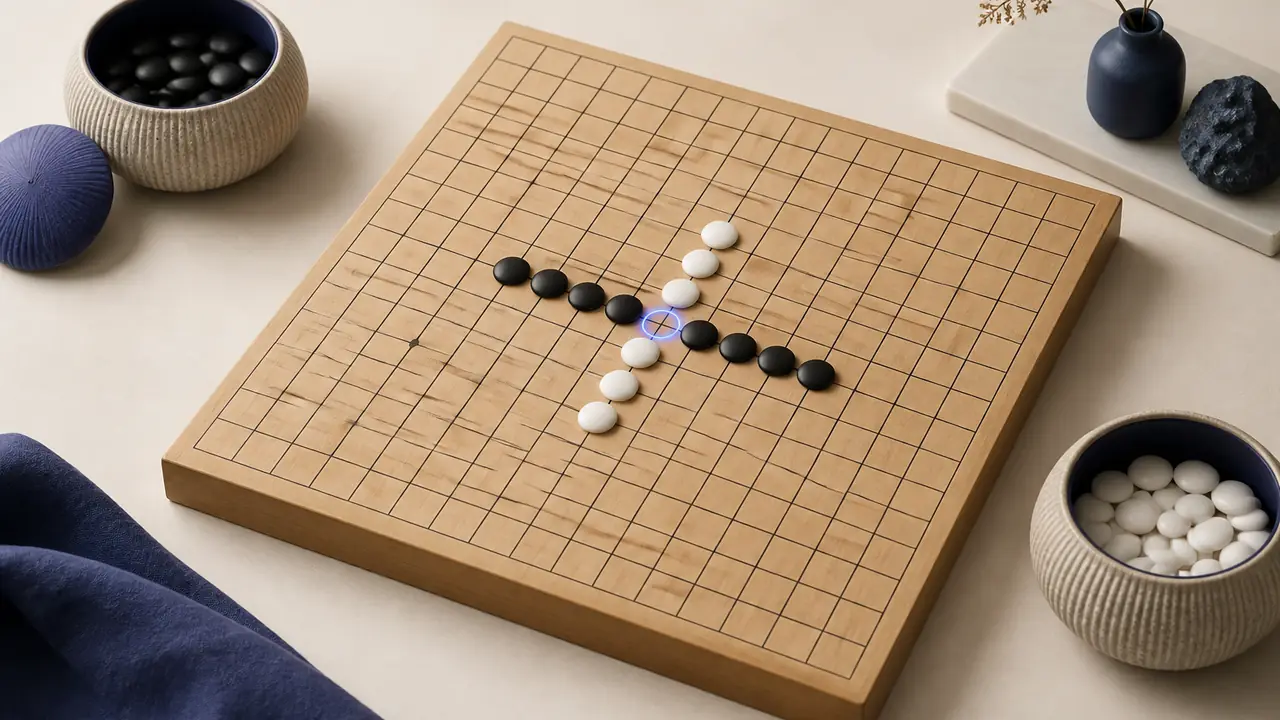
The shapes that force a reply
Gomoku players describe positions in shapes rather than coordinates. There are only four you need day to day, and they form a ladder: each one forces a faster reply than the last. A two is quiet. A three asks a question. A four demands an answer this move. A five ends it.
The word that matters most is open. A shape is open when both of its ends are empty, which means it can grow in either direction. A closed shape — one end blocked by a stone or the board edge — is worth much less than the same length left open. Players lose games all the time by answering a closed three while an open three sits on another line.
The open four is already a win
If black is ever allowed to complete an open four — four in a row with empty points on both sides — the game is over. White can only place one stone, and there are two points that complete five. This is why an open three is answered immediately by anyone who has played more than a handful of games: it is not the three that is dangerous, it is the four it becomes.
The double three: one stone, two threats
Now put two shapes on intersecting lines. If a single empty point sits on both — one horizontal group and one diagonal group, say — playing there creates two open threes at once. White blocks one; black converts the other into an open four; the game is decided two moves later. That empty point is the fork. It often looks quiet until the stone lands.
How to defend before the fork lands
Forks are built out of loose twos, not out of threes — by the time you see two threes, the stone has already landed. Defending well means looking one layer earlier: when your opponent has two separate pairs of stones whose lines cross at an empty point, that point is the fork, and it is usually worth taking before you continue your own plan.
The other defence is counter-attack. A four of your own has to be answered first, no matter what your opponent was building, so a chain of forcing moves can buy you the tempo to block the fork point. Just be sure the chain actually ends somewhere — spending your threats to arrive at the same losing position one move later is the most common way a good defence falls apart.
A third habit helps on a crowded board: after every opponent stone, scan for open threes before you look at your own attack. If there is an open three, answer it. If there is not, ask whether the last stone created a new crossing with an older pair. That second check catches many forks that never look like open threes until it is too late.
Practice on this board
Set the computer to Medium and play ten games with one rule: before every move, name which of your opponent's groups is the most advanced. You will lose some games you would otherwise have won, because narrating slows you down. You will also stop walking into open fours, which is worth far more.
When a game ends, use replay and stop one turn before the first forced reply. Ask what empty point linked two groups. Then play another game with that point type in mind — crossings between a horizontal pair and a diagonal pair are the ones people miss most often. Hard difficulty is useful after that drill starts to feel automatic.
Try it on the board
Hard difficulty will punish a missed fork within a couple of moves.