Opening ideas
Opening moves that keep your options open
There is no single correct sequence for the first few Gomoku moves. A good opening gives your stones room to connect in more than one direction and makes it harder to block all of your useful points with one reply.
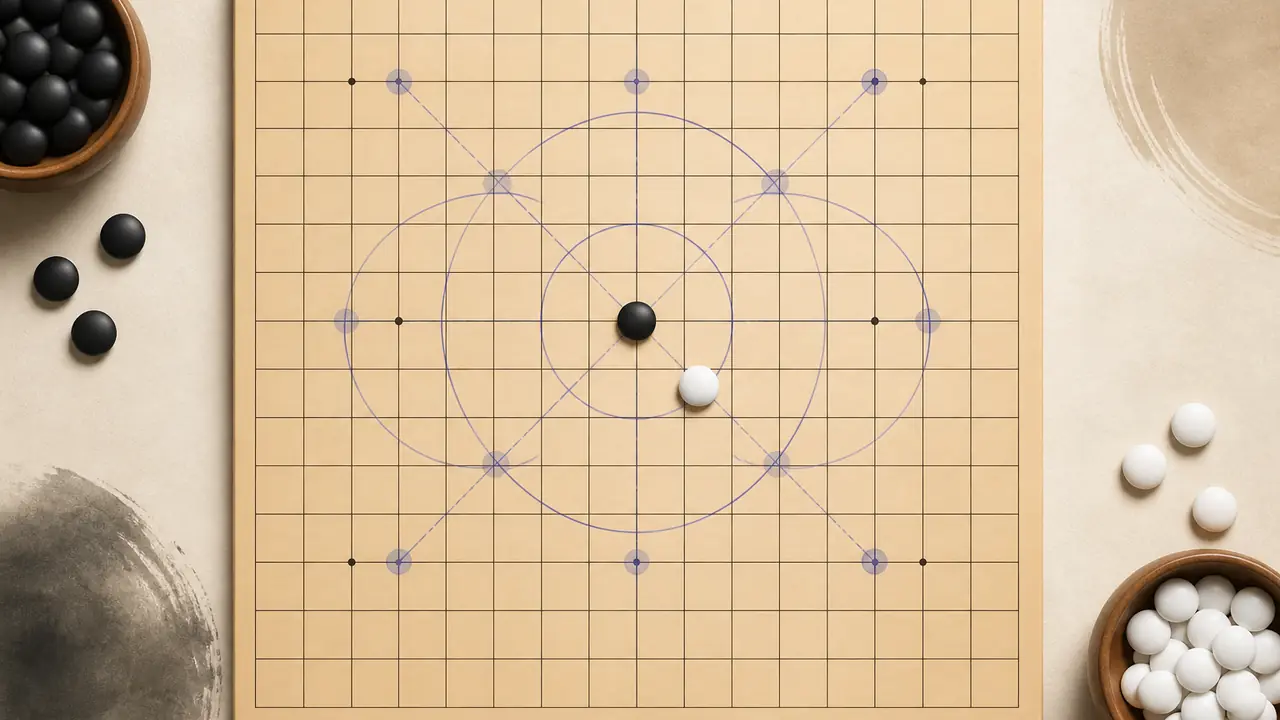
Start near the middle for a practical reason
The centre and nearby intersections leave room horizontally, vertically, and diagonally. A stone near an edge has fewer ways to become part of a five, because the board itself closes one or more directions. This does not make the centre an automatic best move, but it gives a first stone more possible follow-ups when the game is still empty.
In freestyle play, black often opens near the middle and uses the next few stones to keep two directions alive rather than completing an obvious short row. White's job in those early turns is less about matching black stone for stone and more about taking the empty points where black's pairs could later meet.
Do not extend the nearest pair automatically
Two adjacent stones make a clear target. A gap can be more useful when the point that fills it also connects to a diagonal or vertical pair. You do not need to disguise every plan; you need to avoid giving your opponent one simple block that stops all of them.
A useful check before you extend: if your opponent blocks the obvious end, do you still have a second way to grow? If the answer is no, the extension is probably too early. Play the stone that keeps both ways open, even if the board looks less tidy for a couple of turns.
Watch the opponent's empty intersections
In the opening, the dangerous point is often not next to the opponent's latest stone. Look for empty intersections where two of their loose groups could meet. Taking one can block a future double threat while starting a line of your own. That is usually a better use of an early move than extending a pair that still has no second direction.
This is also where many local two-player games go wrong. One person builds a neat row while the other quietly places stones that share crossings. By move twelve, the neat row is easy to block, and the quieter stones are ready for a fork. If that sounds familiar, the double-threat notes show the finished shapes; the opening is where those shapes are prepared.
A practice rule for the first ten moves
For five games, do not move until you can name two directions your stone could grow. This will slow you down at first. It also makes it easier to notice when an early row has only one continuation and is ready to be blocked.
After each game, use replay and stop around move eight to ten. Ask which empty point later became important. Often it is not the centre itself, but a point one step off centre where a horizontal pair and a diagonal pair can share a future stone. Remember that point type for the next opening.
Try a patient opening
Use the replay after the game to find the crossing you missed.