The board's agreement
The freestyle Gomoku rules used here
The basic rule is short: black starts, players take turns placing one stone, and the first connected line of five wins. Different Gomoku sites can still play differently, so this page explains the version used on this board at gomokupro.com.
How a game works on this board
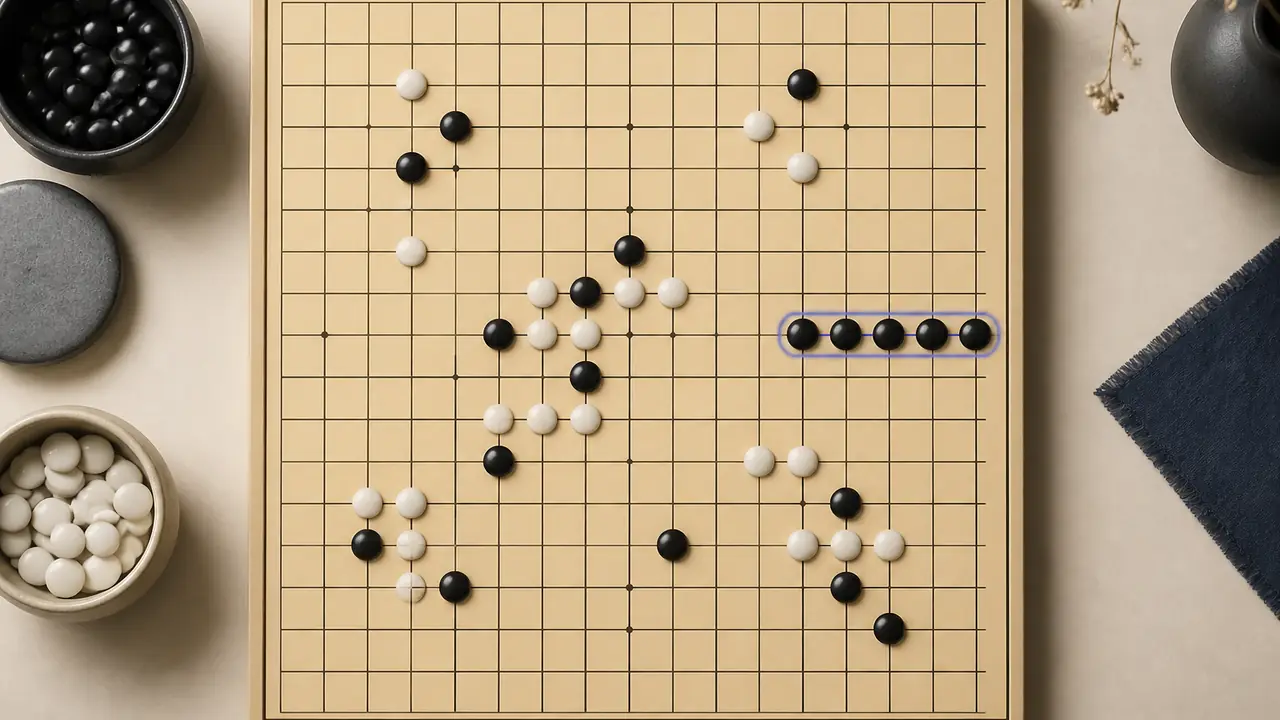
This is a 15×15 freestyle board. Black moves first. Players place one stone at a time on any empty intersection. Horizontal, vertical, and diagonal lines all count. The game ends as soon as either player makes five consecutive stones of their colour.
There are no forbidden black moves here. A line longer than five still wins, and double threes or double fours are allowed. That means you can concentrate on the position instead of pausing mid-game to decide whether a pattern is legal. If you came from a Renju table, the biggest practical change is that black may play shapes that would be banned there.
Stones do not move after they are placed, and there is no capturing. The whole game is about claiming intersections before the other player can. Local two-player mode uses the same rules; the only difference is who is holding the device for the next stone.
What “freestyle” means here
Freestyle Gomoku is the plain version of five-in-a-row: make five, win. Competitive communities often use other systems because freestyle strongly favours black. With perfect play, that first-move advantage is large enough that tournaments invent balance mechanisms. This site stays freestyle on purpose. It is the version most people expect when they sit down for a casual game, and it is the version that lets you learn open threes and forks without memorising a forbidden-move table first.
An overline — six or more in a row — also wins here. Some rulesets treat overlines as illegal or as non-winning. If you ever argue with a friend about whether six counts, you are usually arguing about rulesets, not about the stones on the board. On this board, six counts.
Why other Gomoku rulesets differ
Renju restricts certain black patterns, especially some double threes, so white has a better chance in serious matches. Swap-style openings can let players exchange colours after the first few stones are placed, which reduces the value of going first. Those systems are built for balanced competition. They are not required for a browser board where the goal is a clear game and a readable finish.
If two players disagree about an overline or a double three, they are often assuming different rulesets. On this site, both are legal. When playing somewhere else, check the rules before the first move. It saves the awkward conversation that starts after someone thinks they have already won.
Habits that help under any ruleset
Before placing a stone, look in all four directions. Does it extend your line, block a threat, or keep a useful intersection available? A move that handles two of those jobs is usually stronger than a move that only adds to the nearest row.
After your opponent plays, check open fours and open threes before you resume your own plan. In freestyle, ignoring an open three to chase a slow attack is one of the fastest ways to lose. The double-threat notes cover those shapes with diagrams; this page only needs you to know that they are legal and that they decide most games.
Ready for the first stone?
Play freestyle against the computer or a friend on one device.